SEO vs PPC: Key Differences, Costs, Benefits & Results
Key Takeaway
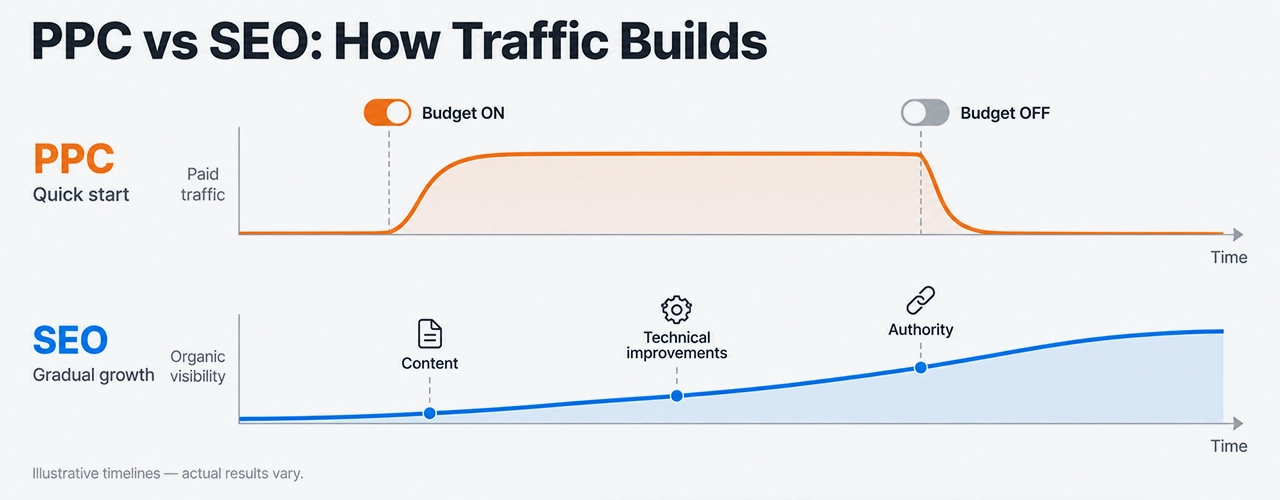
• SEO: SEO is an organic ranking process that occurs over time. It is slow to get going, but will create traffic for you that continues.
• PPC: PPC ranks based on money spent to purchase ads that appear in searches. It is a fast process, but traffic ceases once the budget runs out.
• Cost: SEO has an initial investment requirement but gets cheaper per visitor as time goes by. PPC charges are based on the number of clicks and will never reduce in cost.
• Speed: PPC will allow you to start sending visitors in as little as one day. SEO requires a minimum of 3 to 6 months before showing any effects.
• Trust factor: Searchers tend to trust organic results more than ads. That is why SEO allows you to create better credibility.
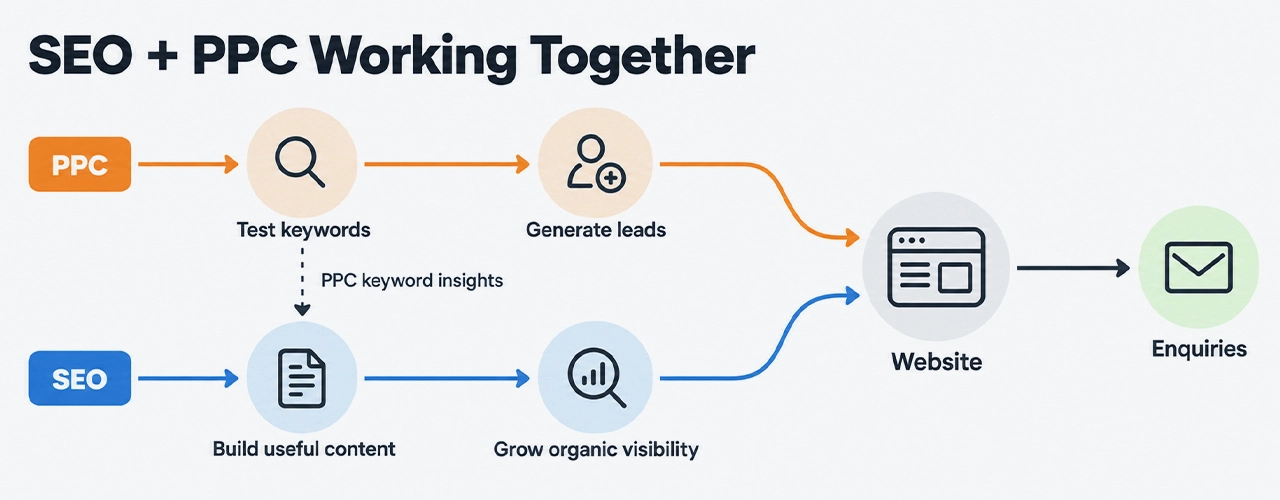
• Best strategy: Both should be used together. PPC helps you collect information and leads quickly.
If you are deciding between SEO vs. PPC, you are really asking one question: should I earn my place on Google or pay for it? Both channels present your company to customers who are already looking for what you have to offer. However, they are entirely different in terms of their cost, effectiveness, and the period of time they require to deliver results. If you make the wrong decision, you will either have to wait for months to get leads you could have obtained weeks ago, or you will spend your entire advertising budget without any tangible outcomes. So, is it better to choose SEO or PPC? Everything depends on your goals, budget, level of competition, and your urgency.
In this blog, we will give an explanation of the differences among these marketing channels, examine their prices, advantages, disadvantages, and outcomes, and help you determine when it is necessary to apply each medium.
What Is SEO?
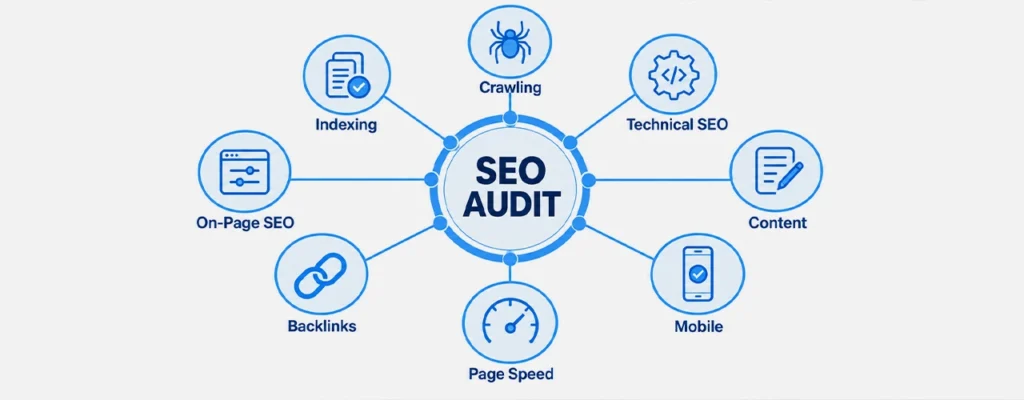
SEO is one of the strategies that makes your website look good in the eyes of Google’s organic search results, where people visit your website at no cost. This is made possible through the implementation of three types of SEO: on-page SEO (good content, keywords, headings, and titles), technical SEO (a fast, mobile-friendly, and secure website that can be crawled by Google), and off-page SEO (good backlinks and mentions of your website). As the ranking is earned and not paid, one good page can bring people to your website for months and even years.
What Is PPC?
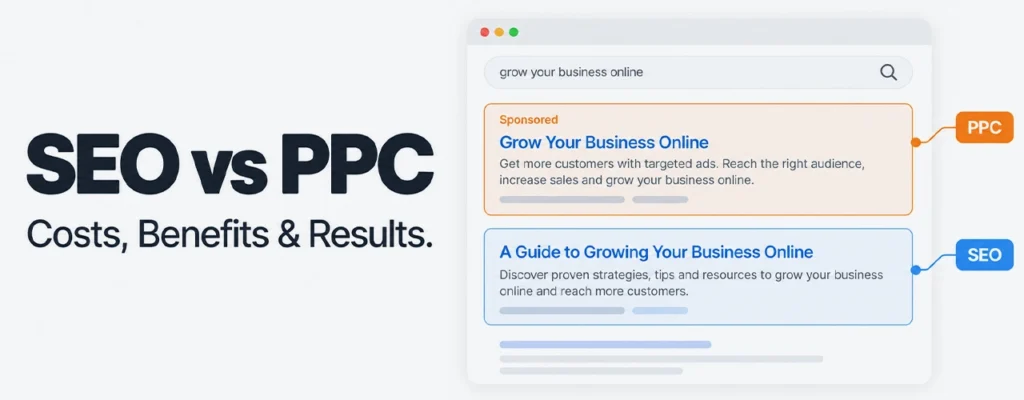
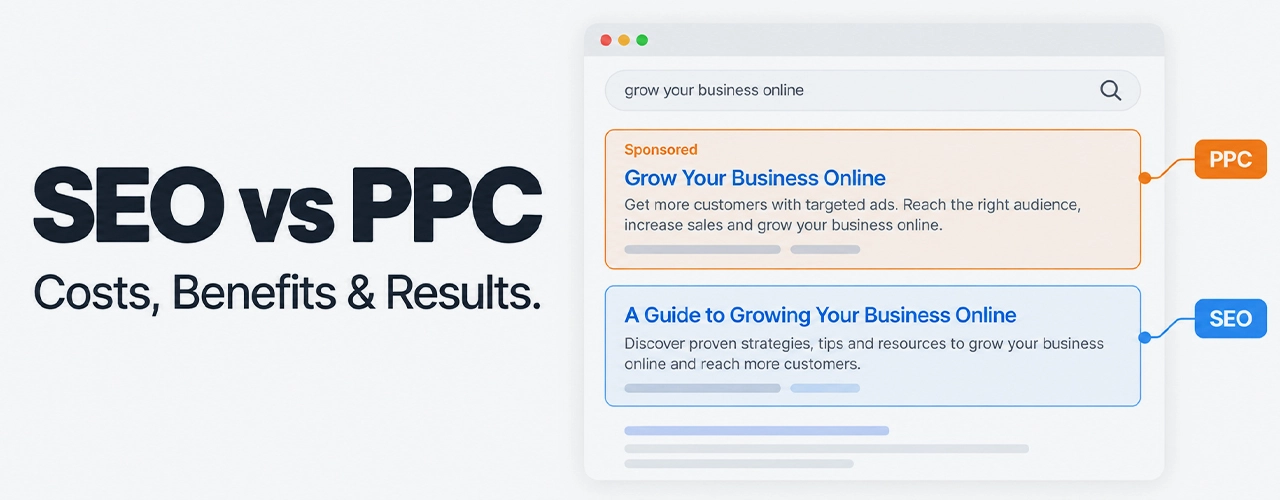
PPC, or pay-per-click, is a paid marketing strategy in which the advertiser pays to have its ads displayed in response to selected keywords that people may type into their browsers. The PPC ads for search require placing the ad on the Google Ads platform, whereby the ad will appear either below or above the listings, indicated as “Sponsored.” As long as the ad is relevant and competitive enough in terms of bid and quality, it will show up almost instantly. The deal is straightforward-no payment, no traffic.
The main difference between SEO and paid advertising is that SEO revolves around organic search visibility, while paid advertising relies on advertisements to gain fast access to users.
Want More Qualified Leads From Google?
Let’s create an SEO and PPC strategy designed around your business goals.
SEO and PPC comparison: A Quick Comparison Table

Factor | SEO | PPC |
Your appearance | Organic | Paid advertisements tagged “Sponsored” |
Cost structure | No cost-per-click; spend money on content, tools, technical expertise, and links. | Paying for every single click according to level of competition and bidding |
Rate of return | Slow – takes about 3 to 6 months for initial benefits, 6 to 12 months for visible improvement | Quick: traffic available just a few hours after launching |
Enduring | If maintained and updated regularly, long-term | Ends with the exhaustion of budget |
Control | Limited – it relies on search engine algorithms. | High: you have control over the keywords, budget, target audience, and schedule. |
Credibility | Usually higher because users perceive it as legitimate | However, this perception can be lower when users know that it is an advertisement. |
Return on Investment calculation | More difficult to measure results, but they come over time. | Easier tracking on a real-time basis, click by click |
Cost per visit over time | Generally low, as you rank better | Stays stable or rises with increase in competition |
Best for | Long-term success, build brand reputation, consistent leads | Launching, deals, testing, immediate demand |
Effort | Continuous creation of content and links | Continuous optimization of the bid, ad, and landing pages |
Benefits and Drawbacks of SEO
Benefits of SEO
- Traffic compounding: Quality content continues to bring people back for a while.
- Cost Effectiveness: You spend less money per visitor, as you do not have to pay for each visit.
- More credible: Your organic ranking can contribute to gaining trust from the target audience.
- Covers the whole funnel of the client journey: Guides, blogs, and service pages can bring customers at all stages of their purchase journey.
- Covers the complete funnel of the customer’s purchasing journey: Guidance articles, blogs, and service pages can help bring customers from any point on the funnel to the website.
- Authority: Useful content allows you to position yourself as a credible company within your field.
Drawbacks of SEO
- Need Time: SEO usually takes months to show results, not days.
- Results Not Guaranteed: This uncertainty is due to algorithm changes as well as the actions of competitors.
- Ongoing Process: Regular optimization of content and websites is needed.
Benefits and Drawbacks of PPC
Benefits of PPC
Visibility: Increase visibility via PPC rapidly.
Testing: Test various offers, headlines, and landing pages to find out which performs best.
Statistics: Monitor clicks and conversions for performance measurement.
Targeting: Target the proper audience according to keywords, geographic location, device type, and time.
Budget: Change your budget whenever you want.
Drawbacks of PPC
Expensive: It may be expensive since competitive keywords may be costly per click.
Traffic stops and payment: The moment you stop paying for the campaign, you will see a significant drop in traffic.
Requires Constant Management: Failure to manage the PPC campaigns may lead to wastage of money.
Avoids Advertising: Some internet users avoid clicking on PPC advertisements.
SEO and PPC Strategy: How to Use Them Together

SEO and PPC do not necessarily need to be competitive against one another. An effective PPC and SEO marketing strategy is one that utilizes both.
- First of all, you can use PPC to learn the search terms that bring you conversions in your PPC campaigns. And then use these terms to create your blog posts, service pages, or landing pages.
- Try out various messaging in your ads in PPC campaigns. The most successful one you can then use as a title or meta description of your site in the SEO campaign.
- Increase your reach. Appearing in both the paid and organic search results can greatly improve your chances of attracting users’ attention.
- Move your budget from PPC campaigns. When some of the keywords provide good ranking positions and traffic through organic searches, then there is a possibility that you will not have to pay for them in your PPC campaigns anymore.
- Target SEO visitors in your PPC remarketing campaigns. The visitors who came to your website via an SEO campaign but did not make any conversion can become your target in the remarketing campaigns.
- Keep an Eye on Both Channels Simultaneously. The performance of both channels can be evaluated by tracking lead generation, cost, and profitability from both SEO and PPC channels.

Common SEO and PPC Mistakes to Avoid
- Wanting to see SEO results in two weeks. SEO requires patience and consistency.
- Driving PPC traffic to a poor landing page. No matter how good your ad campaign may be, the page will need to generate conversions.
- Not measuring conversions. Without measuring conversions, you will never know what works.
- Ranking. Focusing on better rankings rather than better customer satisfaction.
A Quick Note on AI Search and the Future of SEO vs PPC
Search results continue to develop. Google now features AI-powered summaries for many search queries, which can be displayed along with the ads. This emphasizes the importance of relevant, credible, and well-structured content (which will be rewarded by SEO), since such content will easily be found by AI-powered systems. In addition, PPC becomes even more key for those companies that want to be seen without fail in specific search queries.
Conclusion
There is no final answer to the SEO vs. PPC question. The combination that will suit best depends on various factors. For most businesses, the best combination will include both: PPC to gather data and generate leads and SEO to keep costs down and build. Whether you are looking for ways to create a smarter web presence, Techhaz can help you implement an appropriate strategy, whether it be a fast and user-friendly website or a search-oriented approach that will ensure your sustainable development in the future.
Ready to increase your visibility smartly? Contact Techhaz and discuss your SEO and website objectives.
FAQ's
What is the difference between SEO and PPC?
With SEO, you get earned rankings in the search results over time, and you have to pay for placing ads in PPC, which will be charged per click.
Which one is more effective-SEO or PPC?
SEO works better for sustainable traffic growth from search without spending too much money, and vice versa.
Which one is cheaper SEO or PPC?
SEO is usually cheaper since it does not require payment for each click. But in the short run, it is expensive because of the initial investment before any results.
How long will SEO last compared to PPC?
PPC starts generating traffic within several hours of its launch, and SEO commonly takes about 3 to 6 months to show some results and 6 to 12 months for better ones.
Can I use SEO and PPC simultaneously?
Yes, you can. Actually, using both simultaneously will help you get results fast and build up organic traffic for the future.