


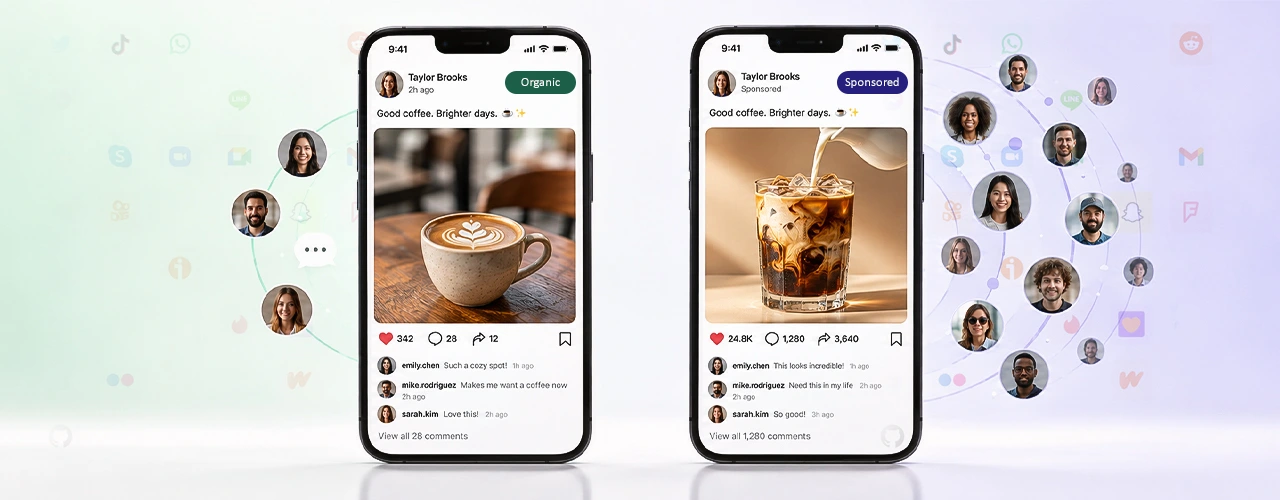
Organic social media is usually the better investment for ongoing customer relationships, useful public content, and demonstrating expertise. Paid social media is ideal when you want to reach a selected target within a specified time and test a particular business offer. Many firms make money on both, but the proper allocation relies on your current constraint: visibility, credibility, conversion or capacity.
If people already visit your profile but cannot understand why they should choose you, buying more reach may achieve little. If your offer converts well but too few potential customers see it, paid distribution deserves a closer look.
The useful question in Organic vs Paid Social Media is therefore where your next hour or marketing dollar will make the biggest difference. This guide explains the trade-offs, the costs that businesses overlook, and how to choose and measure an approach that fits your goals.
Organic vs paid social media at a glance
Decision factor | Organic social | Paid social |
Distribution cost | No platform media fee for ordinary unpaid posts | Advertising budget required |
Other costs | Planning, production, moderation, and reporting | Creative, setup, management, tracking, and landing pages |
Audience access | Followers, discovery, shares, and profile visitors | Delivery guided by campaign settings and platform systems |
Timing | Publishing is immediate; audience development is uncertain | Can accelerate exposure after approval; profitable results require testing |
Strong applications | Education, customer conversations, credibility, and retention | Campaign launches, offer testing, prospecting, and eligible retargeting |
Main limitation | Unpredictable reach and substantial staff time | Spending risk, creative fatigue, and dependence on conversion quality |
After activity stops | Existing content remains available, but visibility may fall | Purchased delivery stops; earlier exposure may still influence later actions |
Neither approach exclusively owns awareness, trust, or sales. A useful advertisement can build credibility, and a helpful organic post can generate an immediate enquiry. The difference is how distribution is obtained and managed.
What is organic social media marketing?
Organic social media marketing means publishing content and interacting with people on social platforms without paying the platform to distribute that content. It includes ordinary posts, videos, replies, community discussions, and direct-message conversations.
An accounting firm answering common bookkeeping questions is using organic social. So is a manufacturer explaining a maintenance process or a retailer demonstrating how to care for its products.
Organic content can reach existing followers and people who discover it through recommendations, searches, shares, or profile visits. However, publishing a post does not guarantee that all your followers will see it.
The word “organic” describes distribution, not the absence of commercial intent. An unpaid post can promote a service, invite a consultation, or generate a sale. Its effectiveness depends on whether the content gives the right person a useful reason to act.
Ready to Make Social Media Work Harder for Your Business?
Turn organic content and paid campaigns into a strategy built around your business goals.
What is paid social media marketing?
Paid social media marketing is when you pay a social media platform to show your ads. You create your ad, set a budget, choose who you want to reach and select where you want your audience to go. You can even track how well your ad is doing.
For instance, you can advertise an event, encourage audiences to request a quote, or pay to promote a product. You might have heard about boosting a regular post. This also comes in paid social media.
Payment provides access to advertising delivery; it does not guarantee sales. Meta, for example, uses an auction and machine learning to decide where, when, and to whom ads are shown. Advertisers influence delivery through their settings, but do not control every impression. See Meta’s explanation of ad delivery.
For this comparison, paid social means platform advertising. Paying a creator to publish a sponsored post is a separate partnership expense; paying to amplify that content through platform ads adds a media expense. Keeping these costs separate makes reporting clearer.
When should your business prioritize organic social?
Buyers need evidence before they contact you
Complex services often require explanation. A potential buyer may want to understand your process, implementation requirements, support arrangements, or ability to solve a particular problem.
Organic content gives those questions a public home. For a software integration business, a post explaining how to prepare data before a migration may be more useful than another general statement about innovation.
Build content around actual sales questions: what happens during onboarding, what the customer must provide, where projects become difficult, and how different options compare. Specific answers help a prospective customer assess fit.
Your existing customers need attention
Social media is also a service channel. Responding to questions, explaining product changes, and acknowledging concerns can support the customer experience. Assign responsibility for replies. A business that publishes frequently but leaves enquiries unanswered has a workflow problem that additional content will not solve.
Cash is limited and relevant expertise is available
Organic social can be a sensible starting point when an owner or specialist can produce useful content without a large production budget. Concentrate on a platform your customers actually use and a format the team can sustain.
That does not make organic free. Ten hours spent preparing posts is ten hours unavailable for delivery, sales, or product improvement. Record that time before deciding that organic is your cheapest acquisition channel.
When is paid social the better option?

You have a time-bound offer or launch
A workshop with a fixed date or a new service entering a market needs exposure within a particular window. Relying entirely on unpaid discovery creates uncertainty.
Paid social allows you to fund a focused distribution test. Start with a clear offer, a relevant audience, and one primary action. A campaign asking people to register should lead to a registration experience that explains the date, value, cost, and next steps.
Your offer works but needs more exposure
Evidence might include sales from referrals, successful direct outreach, or website visitors consistently requesting qualified consultations. Paid campaigns can test whether the offer appeals to a broader audience.
Expect differences between familiar and unfamiliar prospects. An advertisement aimed at people who have never heard of the business may need more explanation than a post shown to existing followers.
You want to re-engage interested prospects
Where platform eligibility and your data permissions allow it, retargeting can help reconnect with people who have previously interacted with your business.
Match the message to the likely question. Someone who watched a product demonstration may need details about installation or delivery. Someone who has already purchased may need support instead of another acquisition offer.
Small audiences can limit delivery, and repeated exposure can become wasteful. Retargeting also reaches people who may have purchased anyway, so a strong reported return is not proof of additional sales caused by the campaign.
Which approach fits your business model?
The following are hypothetical planning examples, not client case studies or promised results.
Business situation | Organic role | Paid role | Outcome to assess |
Local home-service company | Explain common problems and show credible work examples | Promote a defined service in the relevant area | Qualified bookings and completed jobs |
Ecommerce retailer | Demonstrate products and answer purchase objections | Test acquisition offers and suitable follow-up campaigns | Contribution after acquisition costs and returns |
B2B software or IT provider | Explain implementation and answer technical concerns | Distribute a relevant demonstration or assessment offer | Qualified opportunities and eventual customers |
Training provider | Share teaching examples and address course questions | Reach prospects before an enrolment deadline | Suitable registrations and attendance |
Choose platforms using customer evidence: referral data, customer interviews, existing enquiries, and the content formats buyers engage with. A technically complex offer needs an explanation your audience will understand, regardless of which network is fashionable.
Sometimes another channel deserves priority. A person actively searching for an emergency repair is expressing a different need from someone browsing a social feed. Compare social with search advertising and local SEO when immediate search demand is central to the business. Google Search ads are paid search, not paid social.
How much should you spend on organic and paid social?
There is no universal budget split for organic vs paid social media marketing. A fixed percentage ignores your starting audience, production capacity, sales cycle, margins, and ability to measure outcomes.
First separate three budgets: maintaining a useful social presence, producing campaign assets, and purchasing media. Then decide how much additional testing the business can afford.
Compare the full cost of each approach
For organic social, include staff or agency time, production, scheduling tools, community management, and reporting. For paid social, include media spend plus creative, campaign management, tracking, and the relevant share of landing-page work.
Keep platform-only metrics separate from business costs. Cost per lead based only on media spend can help optimize ads, but it cannot describe the complete economics of customer acquisition.
Work backward from an affordable customer acquisition cost
Consider this hypothetical service campaign:
- Media spend: $1,200.
- Creative and campaign management allocated to the test: $600.
- Total campaign cost: $1,800.
- Qualified leads: 20.
- New customers after the sales cycle completes: 4.
The media cost per qualified lead is $60. The fully costed campaign acquisition cost is $450 per customer, before any additional sales costs that have not been included.
If each customer generates $1,000 in contribution after variable delivery costs, $550 remains per customer after the stated campaign acquisition cost, before overhead and omitted sales costs. That is a more useful assessment than celebrating the lead count alone.
Set a target acquisition cost below what the business can sustainably afford, with room for uncertainty. For longer sales cycles, consider cash flow and payback time. Do not justify current losses using unproven future repeat purchases.
Fund a test that can answer a question
If your planning assumption is $75 per qualified lead, a $150 media test implies roughly two leads. That is too little evidence for a confident conclusion about customer acquisition performance. It may still reveal a broken form or an obviously confusing message.
Reduce the number of audiences, offers, or platforms when the budget is small. Splitting limited spend across many variations can leave every result inconclusive.
How to combine organic and paid social media effectively
A combined strategy works when the two activities share customer insights and business goals. It does not require promoting every post.
Choose one business goal
First, decide what you want to achieve. Whether your goal is more consultation requests, new customers, or sales, choose one primary objective and determine how much you are willing to spend to achieve it.
Find out what your customers need
Focus on the questions people ask and the problems they mention. With this you can have an idea what is stopping them from taking the next step.
Share content that helps
Create posts that are useful for your audiences and can solve their problems. Notce what topics get most replies and enquiries from the right audience.
Put money behind what works
If an organic post gets a strong response, consider turning it into an ad. Try to keep message clear enough for people who have never heard of your business.
Make it easy to take action
Your ad should lead people to a page that matches the offer. Keep forms simple, make sure they work on mobile, and follow up with leads quickly.
Check what is actually working
Do not judge an ad by clicks alone. Look at the full journey, from the ad and website visit to the lead and final sale. Fix the weakest step before increasing your budget.
A post with many reactions is a candidate for investigation, not automatic promotion. An entertaining industry joke might attract peers rather than buyers. A less popular explanation of implementation costs could reveal stronger purchase intent.
This is where TechHaz’s combination of content strategy, analytics, CRO, web development, and automation can be relevant: connecting the social message to the website experience and the process that handles the enquiry. The business objective should determine which capabilities are needed.
How to measure organic social media vs paid advertising
Judge each activity by its assigned job, then connect both to business results. Comparing organic likes with paid sales creates a misleading contest.
Use a small set of meaningful KPIs
| Objective | Useful measures | Interpretation limit |
| Audience awareness | Reach, frequency for ads, relevant profile visits | Exposure does not establish buying intent |
| Content usefulness | Substantive replies, saves, shares, relevant enquiries | Engagement may come from people who will never buy |
| Lead generation | Qualified leads, cost per qualified lead, meetings held | Cheap submissions may be unsuitable or unreachable |
| Customer acquisition | New customers, acquisition cost, contribution, payback | Revenue alone does not establish profitability |
| Customer support | Response time, resolution quality, recurring issues | Fast replies are not necessarily helpful replies |
Agree on qualification before launching. For example, a qualified enquiry might require the right service need, location, project timing, and budget range. Avoid changing that definition afterward to make results look better.
Separate traffic sources consistently
Use consistent UTM parameters on links to your website. These labels let analytics identify campaign traffic through fields such as source, medium, and campaign. Google explains their setup in its campaign URL guidance.
Distinguish paid and organic links, preserve campaign information in your lead records where appropriate, and test the complete journey. For leads captured inside a platform or through messages, ensure there is another reliable route into your CRM or reporting process.
Treat attribution as an estimate of credit
Attribution assigns credit to interactions on the path to a conversion; it does not establish that every credited interaction caused the sale. Google’s attribution documentation explains how models distribute that credit.
Someone might discover a business in an ad, read several unpaid posts, and return through a branded search. Reports can differ because platforms use different rules, windows, and available observations.
Do not add every platform’s claimed conversions together and assume they represent unique customers. Reconcile against actual orders or CRM records, and allow enough time for the sales cycle to mature. Where scale permits, use a properly designed holdout or geographic experiment to investigate incremental impact.
Common mistakes that waste social media resources
Buying traffic before fixing conversion problems. If mobile pages are confusing or forms fail, diagnose the destination first. More visitors do not repair the experience.
Treating all engagement as commercial interest. Reactions can indicate attention without indicating customer fit. Read the comments and inspect downstream behaviour.
Expecting organic work to have no cost. Include production and response time, especially when senior employees create technical content.
Optimizing for the cheapest lead. Review qualification, contactability, attendance, and close rates before declaring success.
Changing too many variables at once. A simultaneous change to the offer, audience, creative, and landing page makes it difficult to understand the result.
Ignoring operational capacity. A successful campaign can still disappoint customers if enquiries sit unanswered or the business cannot deliver. Assign an owner for follow-up before launch.
Choose the approach that solves your next business problem
Use organic social media to answer customer questions, demonstrate expertise, and maintain useful conversations. Use paid social media when additional distribution has a clear purpose and the business can measure what happens afterward. Before reallocating your budget, identify where potential customers drop out. If the problem is insufficient relevant exposure, test paid reach. If prospects lack confidence, improve the content. If enquiries fail to become customers, examine qualification, the offer, and follow-up. The better investment is the one that improves that specific outcome at a cost the business can sustain.
FAQ's
Is organic or paid social media better for small businesses?
Organic is a practical starting point when a small business has useful expertise and limited cash. Paid social becomes more attractive when it has a clear offer, a functioning conversion process, and a budget for meaningful testing. Business size alone does not decide the answer.
Can organic social media generate leads without ads?
Yes. Useful content, recommendations, conversations, and profile visits can lead to enquiries without paid distribution. However, unpaid lead volume is not guaranteed. Make the service and next step clear, and track where enquiries originate.
How long does it take to see results from paid vs organic social media?
Paid campaigns can generate exposure after approval, while organic posts can receive responses soon after publication. Establishing repeatable customer acquisition takes longer for either approach. Evaluate outcomes over a period that reflects the buying cycle and produces enough evidence for a decision.
Should you boost posts or create advertising campaigns?
Boosting may suit a straightforward distribution goal for an existing post. A campaign built in the platform’s advertising tools is generally more suitable when you need a structured test tied to lead generation or sales. Available controls vary, so check that the chosen setup supports your objective and measurement requirements.
Should you stop organic posting when ads perform well?
Keep the profile useful and current, but let evidence determine publishing frequency. Prospects may visit it to investigate the business after seeing an ad. Helpful content and responsive communication can support that evaluation without requiring daily posting.