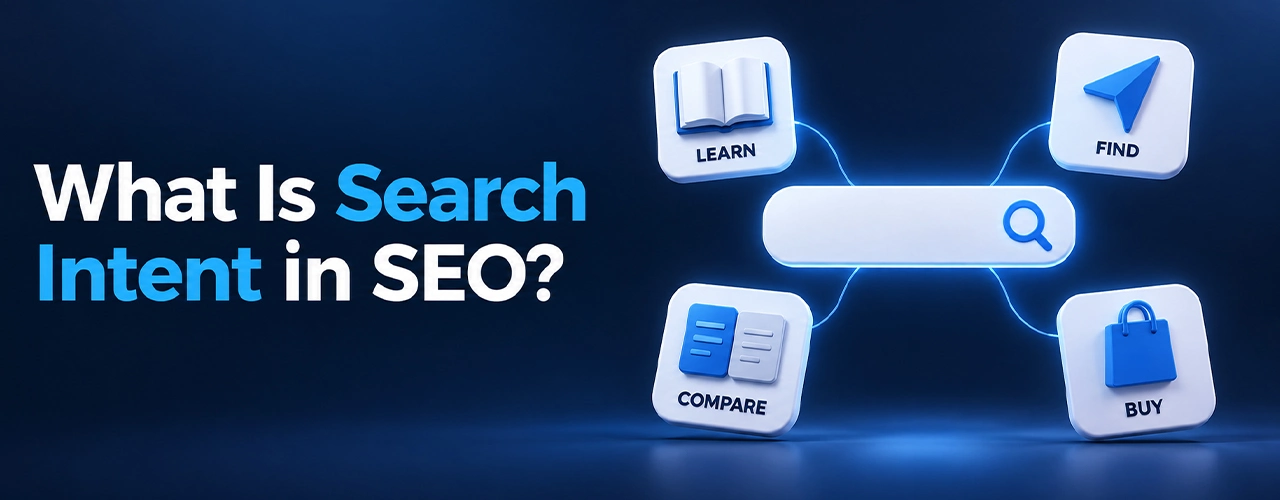
What Is Search Intent? 4 Types Every SEO Strategy Needs
Search intent is the reason why a user types a search query. It’s the information, website, product, service, or action the user is seeking.
Using a keyword is not enough; the page must provide the answer or experience the searcher expects. “How to clean a leather sofa” calls for clear instructions, while “book a sofa cleaning service” needs an action-oriented page.
Search intent helps businesses choose keywords, page types, content, and next steps. It cannot guarantee rankings, but it improves relevance.
What Are the Four Types of Search Intent?
The four main search intent types are:
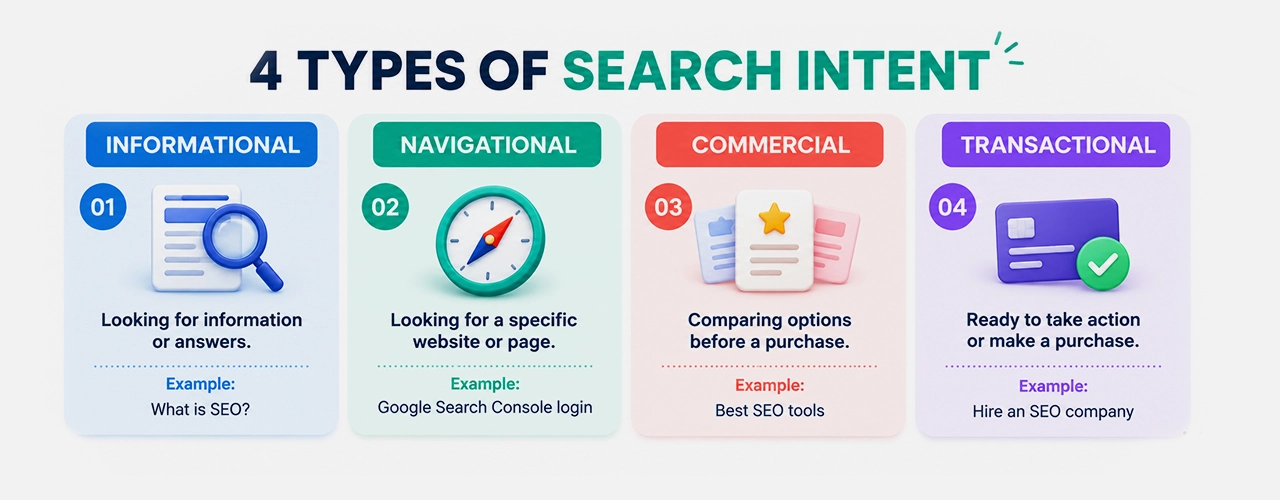
- Informational: The user wants to learn or find an answer.
- Navigational: The user wants to reach a specific website, brand, or page.
- Commercial investigation: The user is comparing options before making a decision.
- Transactional: The user wants to complete an action, such as buying, booking, signing up, downloading, or requesting a quote.
These are practical SEO conventions, not an official Google classification. Some queries reflect multiple intents.
Search intent | What the user wants | Example query | Suitable content | Typical business goal |
Informational | Learn or solve a problem | how to grow basil indoors | Guide, tutorial, definition | Educate and build trust |
Navigational | Reach a known destination | Gmail login | Homepage, login, brand page | Help users find the right page |
Commercial investigation | Compare possible solutions | gas vs electric lawn mower | Comparison, buyer guide, service guide | Support evaluation |
Transactional | Complete an action | book an eye test | Service, product, pricing, booking, or landing page | Generate an inquiry, booking, or sale |
1. Informational Search Intent
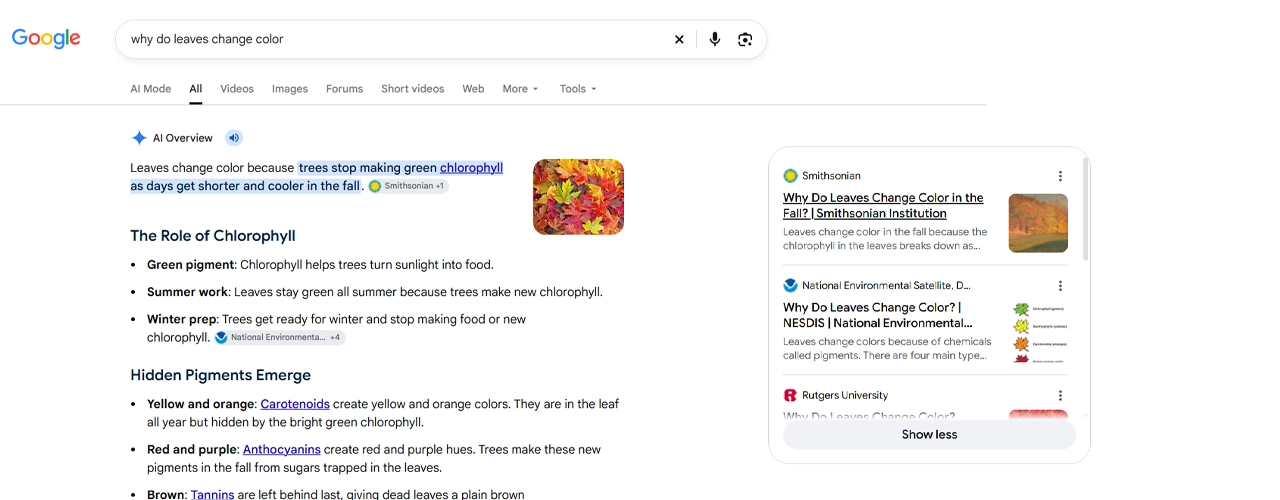
Informational intent appears when someone wants to learn, research, or solve a problem. Queries often include “what,” “why,” “how,” or “guide,” but may simply be “indoor composting.”
Examples include:
- why do leaves change color
- how to grow tomatoes in pots
- why does my laptop overheat
- how to improve home Wi-Fi speed
Useful formats include guides, tutorials, definitions, checklists, and videos. Answer early, then provide enough depth to apply the advice. A guide may lead to a service, but it should satisfy the question first.
2. Navigational Search Intent
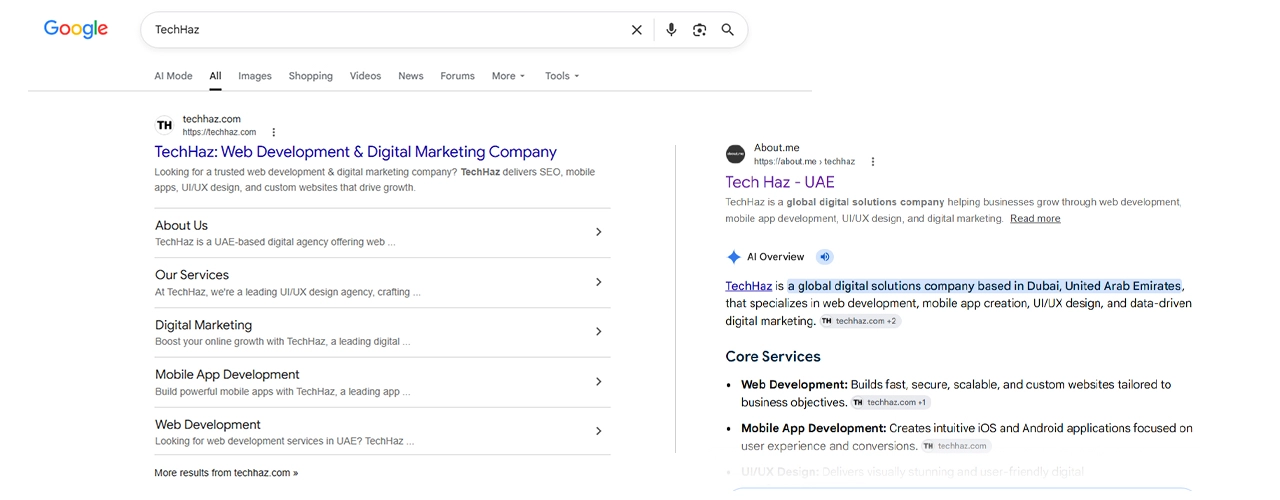
Navigational intent means the user wants a particular destination, such as a homepage, login, product page, platform, or service.
Examples include:
- TechHaz
- Canva login
- Amazon order tracking
- Adobe customer support
If someone searches “Canva login,” they already know where they want to go. A clear login page helps them get there quickly. A search such as “Canva pricing” signals a different task: the person wants plan information. Brand names alone do not tell the whole story; the words around them matter.
3. Commercial Investigation Intent
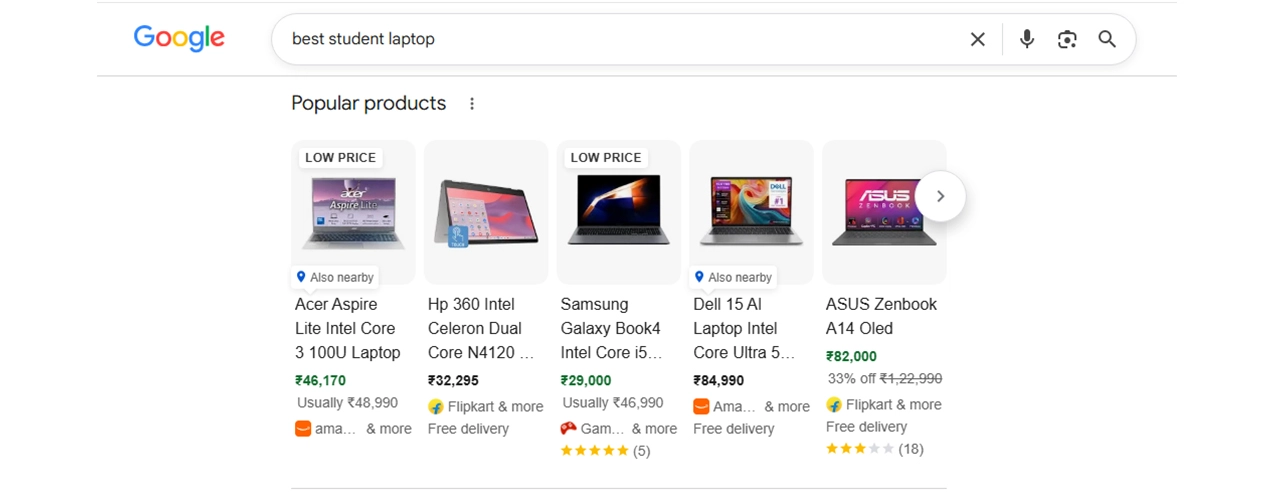
Commercial investigation happens when a user is considering a decision but still needs to compare providers, prices, features, risks, or alternatives.
Examples include:
- best student laptop
- cordless drill vs impact driver
- best family meal-delivery service
- electric car vs hybrid car
- standing desk reviews
Useful content includes comparisons, buyer guides, alternatives, pricing explanations, reviews, and evidence-based case studies. The searcher is weighing choices rather than acting immediately. A comparison may help someone shortlist a laptop; the product page becomes useful once they are ready to buy.
4. Transactional Search Intent
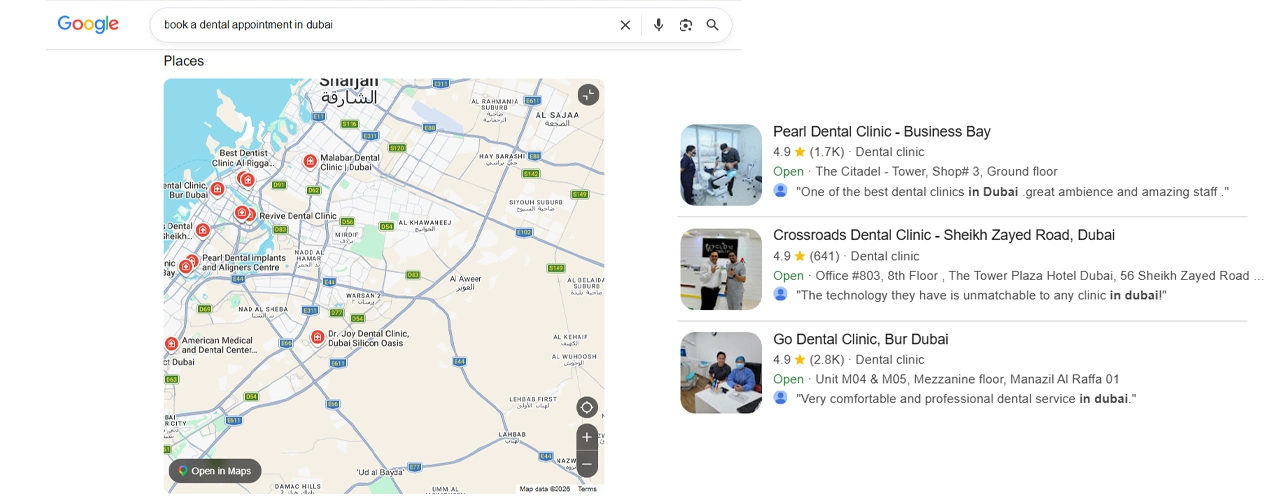
Transactional intent means the user wants to purchase, book, sign up, download, request a quote, or call.
Examples include:
- buy running shoes online
- book a dental appointment
- download a budgeting app
- reserve a hotel room
Suitable destinations include product, service, pricing, booking, sign-up, and contact pages. They should inform decisions and remove friction through clear calls to action.

Is Your Website Matching What Customers Search For?
Identify search intent gaps and optimize your pages to connect with users at every stage of their journey.
Why Is Search Intent Important for SEO?
Search intent connects keywords with relevant content. When the format and information suit the user’s task, the page has a better chance of meeting expectations. This helps with:
- Relevance and format: Teams can address the need with a suitable guide, comparison, service page, product category, video, or local page.
- Keyword clustering: Terms can be grouped by shared intent, not merely similar wording.
- Organic visibility and engagement: Better alignment gives a page a stronger basis for competing, although rankings are never guaranteed.
- Conversion paths and internal links: Each page can offer an appropriate next step.
- Planning: Finding gaps across awareness, evaluation, and action.
Google’s Search Essentials recommends helpful, reliable, people-first content written in the language people use to search. Intent analysis helps put that principle into practice, although the four categories are not an official Google rule.
How to Determine Search Intent
Step 1: Examine the keyword
Transactional intent means the user wants to purchase, book, sign up, download, request a quote, or call.
Examples include:
- buy running shoes online
- book a dental appointment
- download a budgeting app
- reserve a hotel room
Suitable destinations include product, service, pricing, booking, sign-up, and contact pages. They should inform decisions and remove friction through clear calls to action.
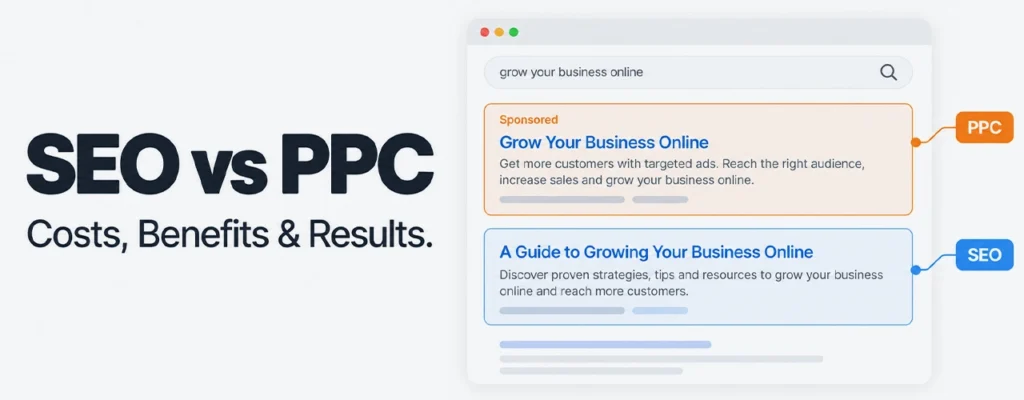
Step 2: Search Google
Review current results, titles, and formats. Note whether guides, commercial pages, local listings, forums, videos, or tools dominate. The same wording can mean different things across industries, locations, and time periods. Results also vary by user and context.
Step 3: Identify the dominant content format
Tutorial-heavy results suggest informational intent; product categories or service pages suggest commercial or transactional intent. A mixture can reveal overlap.
Use the results to understand current expectations, not to copy competitors. The goal is to choose a suitable format and then make the page genuinely useful in its own right.
Step 4: Ask what the searcher wants to do next
Use this simple framework: Learn → Find → Compare → Act
It broadly matches informational, navigational, commercial, and transactional intent. Think of it as a planning aid, not a fixed customer journey.
Step 5: Check SERP features
SERP features provide more clues:
- Featured snippets and People Also Ask often indicate a need for concise information.
- Shopping suggests product research or purchase.
- Maps and local packs signal location-based need.
- Video-heavy results suggest demand for demonstrations.
- Forums may signal demand for experience-based answers.
Use Google Search Console to review the queries producing impressions and clicks. This can reveal whether a page attracts the intended audience or needs a clearer focus.
Match Search Intent to the Right Content Type
Intent | Appropriate page types |
Informational | Blog, guide, tutorial, glossary, educational video |
Navigational | Homepage, brand page, login page, specific destination page |
Commercial investigation | Comparison, buyer guide, alternatives page, detailed service guide |
Transactional | Product, category, service, pricing, sign-up, booking, or landing page |
This mapping is a guideline, so confirm it in current results. For “how does a heat pump work,” an educational guide is a better fit than a sales-led installation page; the guide can still link to that service. For “book heat pump installation,” a glossary entry would make an action-ready visitor hunt for the next step.
Make Search Intent Part of Keyword Research
Build intent into keyword research:
- Discover relevant queries.
- Evaluate volume, competition, business relevance, and specificity.
- Assign a likely intent.
- Validate that assessment in the live results.
- Group keywords that share both a topic and a dominant intent.
- Map each group to an existing or planned page.
- Choose a primary keyword and relevant secondary terms for that page.
Volume alone does not make a keyword valuable. “Coffee” attracts a broad audience, while “buy organic decaf coffee beans” is more relevant to a specialist retailer. It will not necessarily convert better, but business fit matters alongside volume.
Map Keywords to Pages and Avoid Cannibalization
Use this sequence: Keyword → Intent → User need → Page type → Content goal → CTA
Here are three hypothetical examples:
Keyword | Intent and user need | Page type and content goal | Logical CTA |
“how to remove coffee stains” | Informational; learn practical steps | Guide explaining safe cleaning methods | Read a fabric-care guide or explore cleaning products |
“best accounting software for a small shop” | Commercial; compare suitable platforms | Buyer guide covering features and selection criteria | Compare plans or request a demo |
“emergency plumber near me” | Local transactional; contact available help | Location/service page with availability, area, trust details, and contact options | Call or request service |
Mapping also limits keyword cannibalization. Consolidate pages serving the same need or differentiate them by audience, intent, use case, or decision stage.
How to Optimize Content for Search Intent
- Answer early. Do not hide the core definition or recommendation.
- Match the format. Use a comparison for comparison intent, a guide for learning, and a commercial page for action.
- Cover supporting questions. Add relevant subtopics instead of repeating the keyword.
- Offer a logical next step. Link education to deeper resources, support commercial evaluation, and simplify transactional action.
- Supply decision-making detail. Pricing may require cost factors; products may require specifications, delivery, and returns information.
- Review intent over time. Recheck important results and compare search, engagement, and conversion data with the page’s role.
Common Search Intent Mistakes
- Skipping SERP review: Check current result types before choosing a format.
- Assuming only one intent: Record a primary intent and any meaningful secondary intent.
- Choosing the wrong page type: Do not use a blog when users want to act or a sales page when they want to learn.
- Prioritizing volume over value: Weigh relevance, specificity, competition, and business fit.
- Forcing too many keywords onto one page: Group terms by shared need and separate unrelated intents.
- Ignoring branded searches: Maintain accurate destinations for brand, pricing, support, and login queries.
- Mixing unrelated goals: Give each page a clear primary purpose.
- Optimizing for phrases, not needs: Write around the user’s task.
- Using the same CTA everywhere: Match the CTA to the reader’s readiness.
- Never reviewing intent: Reassess pages when results or performance change.
Search Intent Examples for Different Businesses
- Home care: “How often should I water a peace lily?” calls for practical advice. “Buy a peace lily online” calls for plants, prices, and delivery details.
- Travel: “Best time to visit Kyoto” suggests research; “book a Kyoto hotel for April” suggests the traveler is ready to reserve a room.
- Food: “Air fryer vs convection oven” invites a comparison. “Buy an air fryer” needs a product selection and a simple checkout path.
- Local service: “Why is my drain slow?” asks for an explanation; “emergency plumber near me” asks for someone available to help.
- Known destination: “IKEA store locator” points to a particular tool on a particular company’s site, while “IKEA delivery cost” asks for specific information.
Search Intent and Conversion Strategy
Different intents usually need different conversion paths:
- Informational: Read → Learn → Explore a related resource
- Navigational: Find → Visit → Continue the intended journey
- Commercial: Compare → Evaluate → Request details, a demo, or contact
- Transactional: Decide → Act → Purchase, book, sign up, or inquire
Putting Search Intent to Work
Two people may search about the same problem and need very different pages. Someone asking “why is my shower water cold?” wants an explanation. Someone searching “book a plumber today” wants to find help quickly. The first page should answer the question; the second should make it easy to check availability and get in touch.
Before creating or updating a page, look at the query, review the current results, and decide what the searcher wants to do next. Then choose a format that serves that need. Revisit the decision when the results or your audience’s questions change. That simple habit keeps the focus on the person behind the search.
FAQ's
How often should search intent be reviewed?
Review it during updates and when results, performance, or offerings change. Fast-changing queries need more attention.
Should every keyword have its own page?
No. Keywords sharing the same need can share a page. Separate them when audience, intent, topic, or action differs.
How do I optimize a page for search intent?
Answer early, use the right format, cover supporting questions, offer a next step, and review performance.
How does search intent affect content strategy?
It determines which topics need guides, comparisons, service, product, or local pages and informs links and CTAs.
What is the difference between commercial and transactional intent?
Commercial intent centers on evaluation; transactional intent centers on action. They can overlap, especially for service or pricing queries.