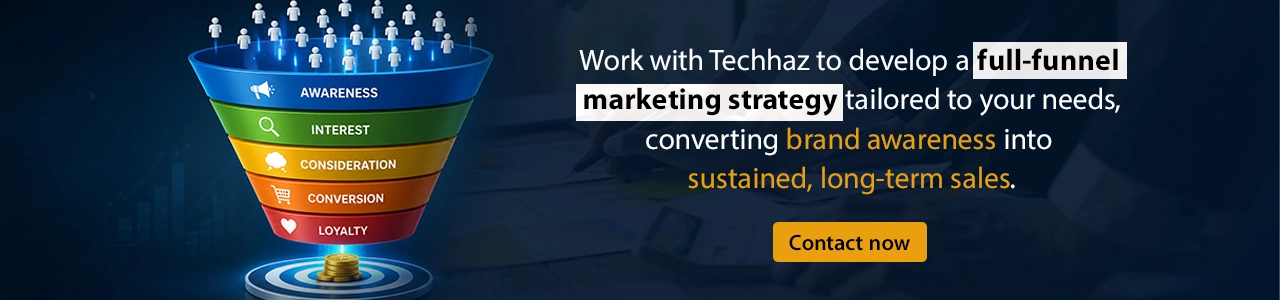

Customers now engage with brands on search engines, social media, websites, emails, and e-commerce sites. But attracting visitors to your website is just the first step. With full funnel marketing, companies can take their prospective customers along their purchasing journey from awareness to conversion and beyond.
Regardless of whether you are operating a startup or have an existing business, knowing about marketing funnels can assist you in creating better marketing campaigns and improving conversions. This post will discuss everything there is to know about full funnel marketing and how to develop a strategy for it.
What Is Full Funnel Marketing?
There are a lot of organizations asking themselves what full funnel marketing is before starting to plan their campaigns. This is marketing where you actually take your consumers through their whole purchase cycle as opposed to simply trying to buy them at the point of sale.
It is unlikely that a customer buys something right after meeting the brand for the first time. They get familiar with it, learn more about different alternatives, read reviews, check out the site, and only then make the decision. This is how a digital marketing funnel works. An effective full-funnel marketing strategy will provide customer support on their way to making the decision.
Understanding the Digital Marketing Funnel
The digital marketing funnel demonstrates the path that customers have to take before making a purchase. Typically, the funnel consists of three stages, which are awareness, consideration, and conversion. These stages help companies interact with potential customers appropriately.
During the first stage, a business introduces its brand to the audience. The second stage involves comparing the options and searching for relevant information. The last one means taking action, which includes buying something, ordering services, or filling out the form. Failure to cover any of those stages can bring you fewer conversions.
Various Phases of Online Full-Funnel Marketing Strategy
The following are the different phases of an online full-funnel marketing strategy:
Stage 1: Awareness – Top of the Funnel (TOFU)
This phase is about creating awareness about your brand and driving traffic to your website/page. This stage is not about selling anything.
SEO, blog content, social media posts, videos, infographics, and ads can attract a new audience and lead people to your website.
Stage 2: Consideration – Middle of the Funnel (MOFU)
People have heard about your brand, but they are looking for more information and comparing all of their choices.
Techniques: Case studies, comparison pages, webinars, customer testimonials, email campaigns, guides, and other useful materials provide more options for the potential customer.
Stage 3: Conversion -Bottom of the Funnel (BOFU)
Now customers have made up their mind about the product or the company, and they are ready to buy. At this stage, you can provide detailed information to help them.
Techniques: Product demos, consultations, FAQs, customer reviews, transparent prices, call-to-action prompts, and easy-to-fill forms can assist customers in making a decision.
Stage 4: Retention and Repurchase
The interaction between the client and the company does not end with one purchase. Staying in touch is an important step to persuade the customer to buy your product or service again.
Techniques: Emails, special offers, loyalty programs, customer service, recommendations, and opportunities to buy more expensive services can help you reach this goal.
All four stages are interconnected. Consumers go through them at different moments. Successful cooperation between them will bring results, such as attracting customers, building trust, increasing sales, and retaining them.
Why Is It Important to Go for Full Funnel Marketing?
Consumers need more than just advertisements. Consumers seek valuable information and meaningful communication, as well as something that makes consumers trust a business before purchasing something. Full-funnel marketing will assist the business in identifying the right consumers, establishing a relationship with valuable content, converting consumers into leads, answering their inquiries, making conversions, and ensuring repeat business from customers. The business does not need to conduct a single campaign; it needs to maintain connections with the customers throughout their purchasing process.
Top of the Funnel: Building Awareness
In the awareness phase, your brand meets new customers who might never have heard about you. In this phase, it is better to educate your customers rather than sell anything.
The following methods could help companies attract new customers: blogs, informative videos, social media posts, basic guides, and other helpful materials that provide answers to frequent questions or solve regular problems.
In this stage, the foundation of the customer acquisition funnel is formed as it attracts the proper audience to your business and helps them advance further to the next stage of the buyer’s journey.
Middle of the Funnel: Establishing Trust
After people become aware of your business, they start comparing various alternatives.
In this stage, most purchases are usually made as customers seek evidence that your product will address their needs.
Content at this stage should be used to answer specific questions, provide details on your products’ benefits, and eliminate doubts. Case studies, comparison pages, webinars, white papers, product demos, and testimonials are commonly utilized by businesses in this stage.
An effective lead generation strategy also plays an important role in this stage, as you do not ask your visitors to make a purchase but rather engage in some less demanding activities like downloading something, subscribing to newsletters, and booking consultations.
Bottom of the Funnel: Interest to Conversions
At the end of the funnel, clients know about the problem and shortlist potential solutions. What they need now is assurance before making the final choice. These include clean product or service pages, clear prices, good customer reviews, FAQs, and easy-to-contact methods, which will enable customers to make better-informed decisions.
The company should concentrate on optimizing the sales funnel by ensuring that the website is fast, eliminating unnecessary form fields, making navigation easy, and facilitating a fast checkout process. Little changes at this level can lead to significant improvement in conversion rates as customers are ready to make their final choice.

Funnel Strategy for Digital Marketing
To implement an efficient funnel strategy for digital marketing, all channels have to work together and not separately. It is wrong for organizations to consider SEO, content marketing, PPC, e-mail marketing, and social media marketing as standalone activities. Rather, there should be an integration of all the above-mentioned media to offer the consumer a smooth customer experience.
A good digital marketing funnel approach will include the following stages:
- Attract the right audience through quality content and SEO.
- Educate and nurture the audience through quality information.
- Turn them into customers using an appropriate call-to-action.
- Support customers after their purchase.
Marketing will be much more effective when all its stages support each other.
Why Do Companies Prefer Techhaz for Full Funnel Marketing?
Building a good marketing funnel is more than just producing content and running some ads. All the stages of the process should be interrelated to provide the best customer experience. At Techhaz, you can get a marketing strategy that will attract relevant visitors, encourage their engagement, convert them into leads, and drive more sales. The company’s specialists do everything necessary to bring measurable business results by optimizing SEO, developing content, setting up paid campaigns, optimizing landing pages, and monitoring conversions.
Instead of offering the same marketing strategy for every business, Techhaz developed a customized marketing plan for each client depending on the industry, customer behavior, and goals. Businesses that want to choose a good full-funnel marketing agency need a strategy combining these two things.
Conclusion
In full-funnel marketing, businesses create a link between each step of the customer’s journey instead of separating marketing into several tasks. The stages of raising awareness, developing trust, enhancing conversions, and attracting returning customers all play a role in creating sustainable business development. Knowing what full funnel marketing is is just the first step in the process of its implementation. To make a company successful, it needs to create valuable content and guide the customer through the journey with relevant information.
With customer expectations changing continuously, companies need to have a full-funnel marketing strategy that will allow them to get quality leads, boost conversion rates, and establish healthy customer relations. By doing this, businesses will be able to grow sustainably. It is only with the right strategy and the help of Techhaz that such success can be realized.
See also: Local SEO Strategies to Help Small Businesses to Get More Customers