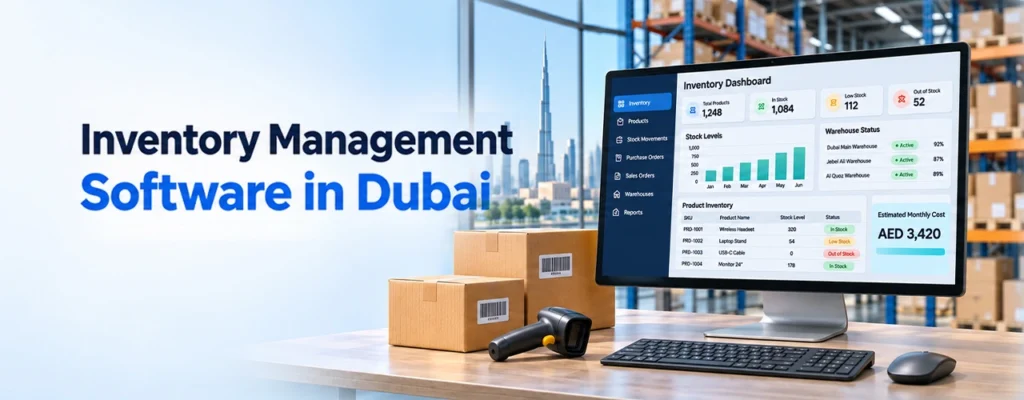
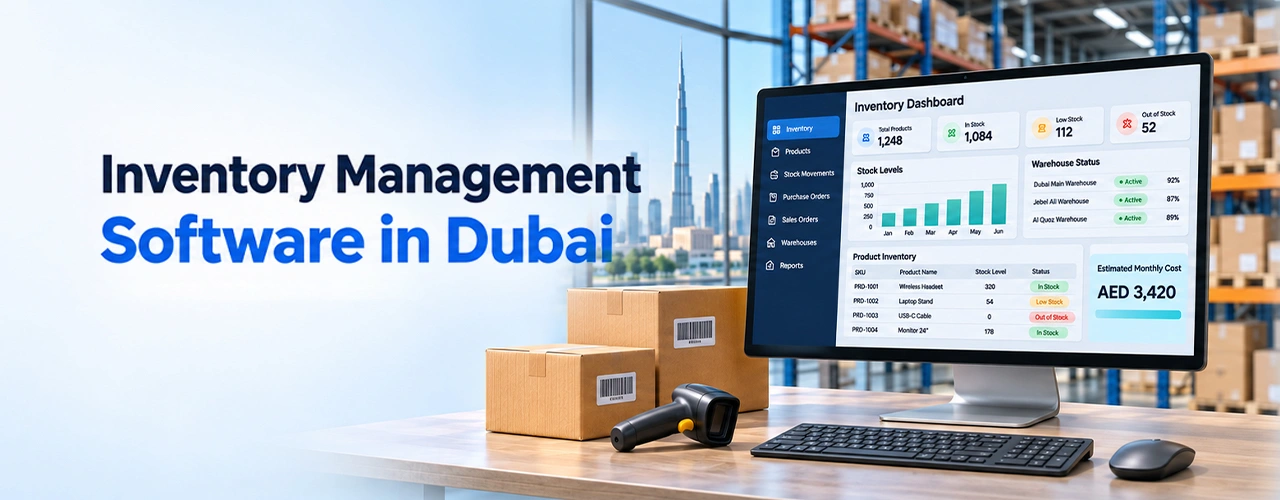

Inventory Management Software in Dubai: Features, Benefits & Costs
Key Takeaway
- Inventory management software in Dubai helps businesses track stock, coordinate warehouses, and ship orders instantly.
- Real-time tracking and barcode scans help spot stock errors early.
- Automated alerts warn you, so shortages don’t catch you off guard.
- The right inventory management software modules make warehouse work a lot simpler.
- Your costs depend on the features you pick, how much you customize, and how big the business is.
- The best inventory management software aligns with your business operations and stops overselling.
When a business grows in Dubai, the workload grows with it, usually faster than owners expect. Tracking stock, running several warehouses, and getting orders out on time all become harder once the work starts piling up. Typing huge amounts of data by hand invites mistakes. Those mistakes usually turn into empty shelves, late deliveries, and money lost for nothing.
A good inventory management software in Dubai takes most of that pressure off your team. Stock counts stay correct, product movement is easy to follow, and buyers can order based on real numbers instead of rough guesses.
The Emirates News Agency (WAM) reported that the UAE’s e-commerce market is projected to reach AED 67.2 billion by 2030. As online sales grow, reliable inventory control helps you keep up with what customers expect.
What Is Inventory Management Software?

The best inventory management software considers every product from the purchase order to the final delivery. Instead of juggling paper registers and endless spreadsheets, you get one system where all your stock details live.
A retailer can see what is actually on the shelf before promising an order to a customer. Wholesalers keep an eye on stock in different warehouses, and online sellers update their quantities the moment a sale goes through.
Over time, the data starts telling you things. You notice which products practically sell themselves, which ones sit around for months, and where your purchasing money is really going. Depending on the system, it can also link with accounting tools, online stores, barcode scanners, and ERP platforms.
Take Control of Your Inventory
Simplify stock tracking, reduce manual errors, and manage your business inventory more efficiently.
Key Inventory Management Software Features to Look For
The right features depend on your business size and its daily operations. However, there are some features that are commonly used by most of the companies.
1. Real-Time Stock Tracking
Every receipt, sale, return, and transfer updates inventory straight away. Employees see the real numbers without chasing anyone for a report. That means fewer overselling slips and fewer counts that don’t match.
2. Barcode and QR Code Scanning
Barcode scanning identifies the products and counts the stock faster. A quick scan at receiving, picking, packing, or dispatch is all your staff needs. Typing errors fade away, and orders leave the warehouse much sooner.
3. Multi-Warehouse Management
When stock sits in more than one warehouse, a clear view of each location saves time and money. The system logs quantities site by site and handles transfers without the usual back-and-forth. Staff can check what is on hand before they raise a fresh order.
4. Automated Reorder Alerts
When stock falls to a minimum level, reorder alerts notify employees right away. Some systems also consider sales trends and supplier delivery times. That way, businesses can add essential products before the shelves run empty.
5. Reporting and Analytics
A good report tells you what is flying off the shelves and what has been gathering dust for months. Managers can then buy with a clear head, trim spending, and spot slow-moving stock early. Strong inventory management software features like these make stock control feel far less like guesswork.
Benefits of Inventory Management Software for Your Business
An effective inventory system can improve daily operations in several ways.
- Fewer stock errors: Automatic updates help a lot. Your system records and the real inventory stop drifting apart.
- Lower storage costs: See the details early, and you will buy less you don’t need. Excess stock stops piling up.
- Faster order fulfillment: Workers find products quicker, so shipments go out without much fuss.
- Improved customer service: Real-time data means you tell customers what is truly in stock. No guessing, no false promises.
- Smarter purchasing: Sales reports show managers where demand is heading. Planning the next order feels far less like a gamble.
- Better visibility: Warehouses, branches, and sales teams all look at one system. Nobody has to ask what is where.
Essential Inventory Management Software Modules

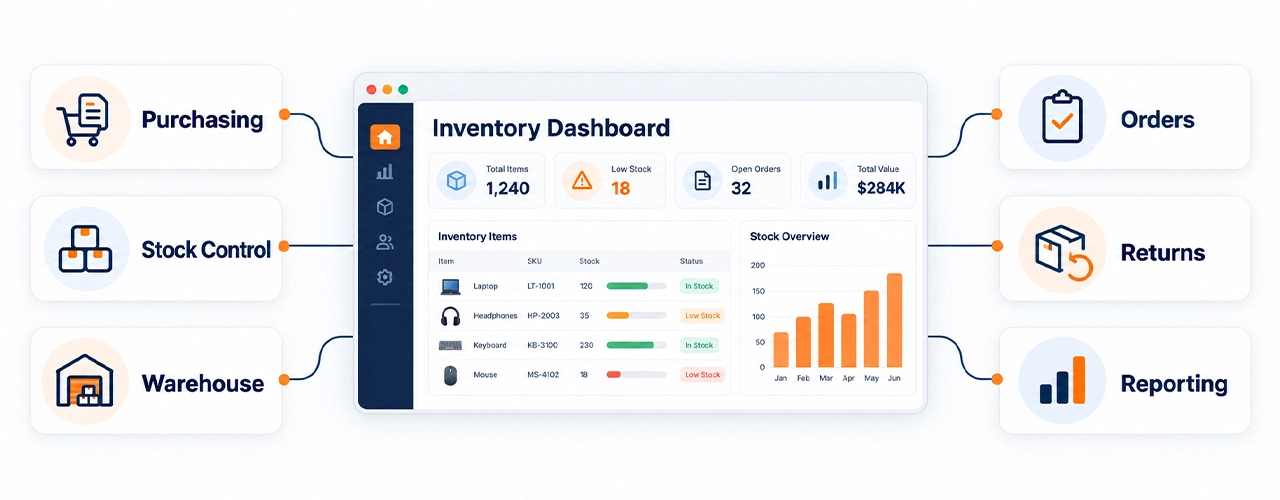
The most useful inventory management software modules should be able to help with the following areas: purchasing, inventory stock monitoring, operation of warehouses, and reporting.
- Purchasing and supplier management: Record orders and follow deliveries as they arrive. Supplier details stay in one place.
- Stock control: Watch quantities and product variations. Damaged items and corrections go on record too.
- Warehouse management: Set up where goods are stored. Moving them between locations takes a few clicks.
- Order management: Match each customer order to stock you really hold. Nothing gets promised that you can’t ship.
- Returns management: Note what comes back and what shape it’s in. Stock levels then adjust to fit.
- Reporting and forecasting: Look at how stock has moved lately. That gives you a decent idea of future demand.
How Much Does Inventory Management Software Cost in Dubai?
Several things move the price: user numbers, how many products you hold, warehouse locations, integrations, and any custom work.
The following figures are just budgeting estimates.
|
Software or service |
Estimated cost in AED |
Best suited for |
|
Basic cloud software |
AED 100-1,000 per month |
Small shops and startups |
|
Advanced inventory system |
AED 1,000-5,000+ per month |
Growing retailers and distributors |
|
Custom software development |
AED 15,000-100,000+ one-time |
Businesses with specialized workflows |
|
Implementation and integration |
AED 2,000-25,000+ one-time |
Setup, migration, and system connections |
What Affects the Total Cost?
Several factors influence the overall budget:
- Business size: A bigger team, a longer product list, or one more location, and your subscription fee goes up.
- Customization: Custom workflows and dashboards take developers time. You pay for every hour of it.
- Integrations: Hooking up accounting tools, marketplaces, or an ERP usually brings surprise charges. Few buyers plan for them.
- Training and support: Your team needs onboarding, and technical help isn’t free either. Both lift the first bill.
- Maintenance: Updates, backups, and security upgrades keep coming, so support slowly eats into your budget.
How to Choose the Right Inventory Management Software
Price alone won’t tell you which one is the best inventory management software in Dubai. First, pin down what keeps going wrong, whether that’s stock gaps, late replenishment, or little warehouse visibility.
Follow these steps before making a decision:
- List your requirements. Write down your product categories and stock locations. Add the sales channels and the reports your team relies on.
- Check integrations. Your website and accounting tools should connect smoothly with the system. The same goes for any marketplaces you sell on.
- Consider growth. Pick software that won’t struggle as you expand. More products, more staff, or a new warehouse next year should not cause trouble.
- Review security. Look for user permissions and regular backups. Audit trails matter too, since they show who changed what.
- Request a demonstration. Ask the vendor to walk through receiving and stock transfers. Have them handle returns while you watch.
- Compare total costs. Add up subscriptions, setup, and training. Include maintenance as well before you commit to anything.
Online sellers need the best e-commerce inventory management software to match orders and stock across each sales channel they use. That way, nothing gets oversold, and customers always see the right availability.
Improve Inventory Control With the Right Technology
A good inventory system will not only help your business cut down on errors, keep your spending in check, but also enable you to quickly get hold of stock in a customer demand.
Before you decide, look at the features, implementation, and costs of a project for a longer period of time. Select an inventory management software in Dubai that would be in line with your operations and also support your purchasing plans.
At TechHaz, we create solutions to fit business operations, from custom software development for e-commerce to technology products tailored to business needs. We are all about delivering workable solutions that can really transform businesses by enhancing their operational efficiency while enabling business growth.
A good technology partner can help you build an inventory system that fits your business now and later.
FAQ's
Is cloud inventory software suitable for small businesses?
Yes. You can log in from anywhere, and updates install on their own. Upfront costs are usually lower too. Read the subscription limits before you pick a plan.
Can inventory software connect with accounting tools?
A great number of systems offer integration features or provide APIs to third-party developers. Make sure that the chosen combination of software is mutually workable so that manual work of copying data does not need to happen.
How long does implementation of inventory management software in Dubai take?
In the simplest case, one day is enough for the setup, while a fully integrated system may be delivered over weeks, or even months.
How do I find the best inventory management software?
Look into features, integrations, reporting, security, support, etc., and total ownership costs, then decide only after you have done your tests.
Can inventory software manage multiple warehouses?
Most systems can track stock by location, move it between sites, and pull everything into one report. Check that your plan includes all three.