


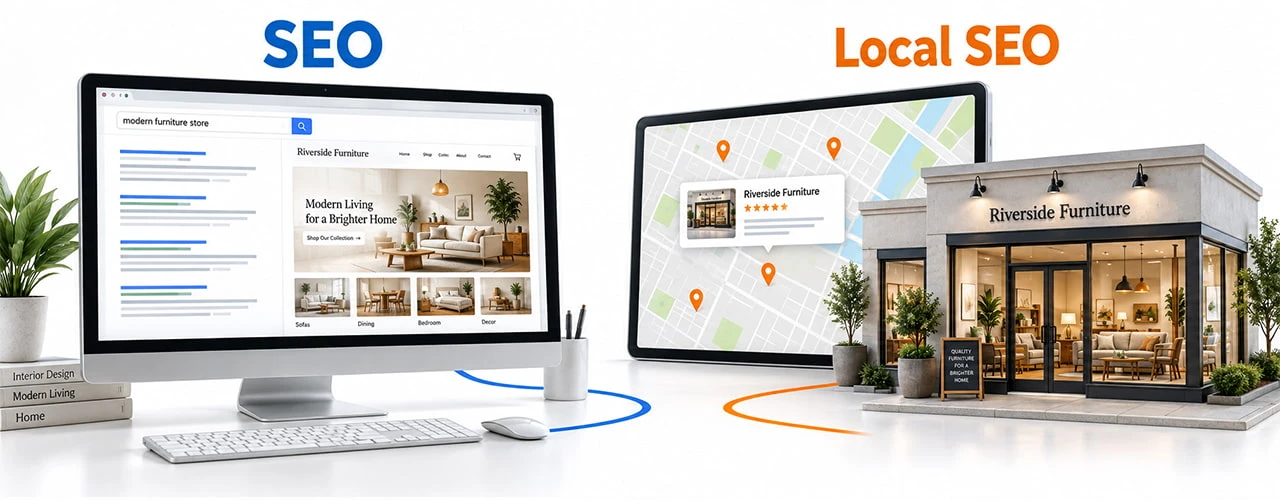
SEO and Local SEO both help businesses improve their visibility on Google, but they target different types of searches. SEO helps websites rank for broader searches related to products, services, and information, while Local SEO helps businesses appear in location-based searches, Google Maps, and local results. Choosing the right strategy depends on your business type, target audience, and how customers search for your services.
A business selling accounting software nationwide needs to reach people searching for a suitable product. An accountant serving a particular city also needs to appear when someone looks for a nearby professional. A firm offering both local appointments and nationwide online services may need both approaches. Understanding that distinction helps you spend your marketing budget on searches that can lead to customers.
SEO vs Local SEO: Key Differences
The difference between SEO and Local SEO is primarily the audience, search context, and work needed to reach that audience.
Factor | Traditional SEO | Local SEO |
Main goal | Attract relevant visitors through organic website visibility | Reach customers searching for businesses in a particular area |
Target audience | People interested in a topic, product, or service across the markets served | People in, near, or planning to visit a relevant location |
Search intent | Learn, compare, find a provider, or buy | Find, evaluate, contact, or visit a geographically relevant business |
Search visibility | Organic website listings and other eligible search features | Maps, local pack listings, and local organic website results |
Ranking considerations | Content relevance, links, technical accessibility, and other search signals | Local relevance, distance, and prominence; website signals also matter for local organic results |
Optimization methods | Technical SEO, useful content, internal linking, and earned backlinks | Website SEO plus business profiles, reviews, listings, and location information |
Typical business fit | SaaS, e-commerce, national brands, and online service providers | Restaurants, clinics, shops, trades, and businesses serving defined areas |
Measurement | Organic traffic, search visibility, qualified leads, and sales | Local visibility, profile interactions, bookings, qualified calls, and location-level results |
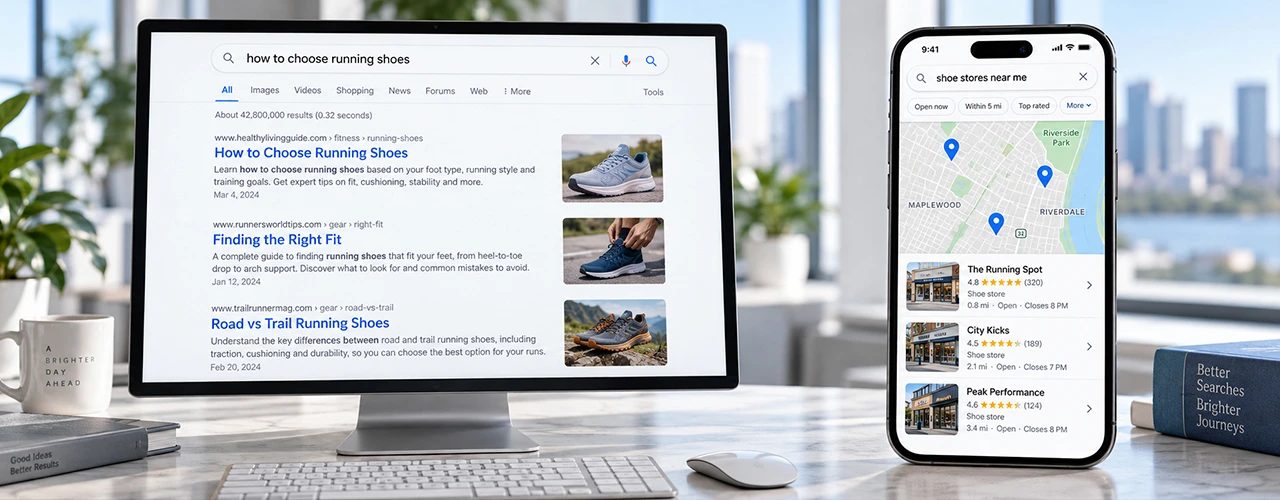
Consider two searches: “how to choose office furniture” and “office furniture showroom near me.” The first invites research content. The second calls for nearby options, opening hours, and a practical route to visiting. A retailer with an online store and a showroom can benefit from both.
What Is SEO?
Search engine optimization, or SEO, is the work of making your website easier for search engines to discover and understand, while making its pages more useful to the people you want to reach. Organic results are unpaid search listings. You do not pay Google for each organic click, although the research, content, development, and ongoing maintenance behind SEO require investment.
Search engines discover pages, process their content, and select results relevant to a query. A technically accessible page still needs to offer useful information; being indexed does not guarantee a strong position. Google explains how Search works.
In this blog, “traditional SEO” means website-focused SEO aimed at relevant search demand, often across a wider market. It is not inherently national or global: the same techniques also help a local business website.
The benefits of SEO for businesses include reaching potential customers during research, product comparisons, and purchase decisions. For example, a software company could use separate pages to answer “how to automate invoice approvals” and explain its invoice approval software. Those searches represent different stages of the buying process.
Your Next Customer Is Already Searching. Will They Find You?
Identify the gaps limiting your search visibility and turn relevant searches into real business opportunities.
What Is Local SEO?
Local SEO improves a business’s visibility when location matters to the searcher. It helps people discover businesses they can visit or businesses that travel to serve them.
Examples include “vegetarian restaurant in dubai,” “plumber near me,” and “physiotherapy clinic.” A city name is not always necessary: Google can recognize local intent and use information about the searcher’s location.
Local search optimization can support visibility in three places:
- Google Maps.
- The map-based business listings shown within Google Search, often called the local pack.
- Ordinary organic website results for geographically relevant searches.
A Google Business Profile helps eligible businesses provide details such as their services, location, opening hours, and contact information. It is a central part of local visibility, but the website still helps customers evaluate the business.
Google identifies three main considerations for local rankings: relevance, or how well a business matches the search; distance, or how far it is from the searcher; and prominence, or how well known it is. This means even a well-optimized business should not expect the same Maps position everywhere. Google’s local ranking guidance.
How Traditional SEO Works
Keyword research starts with customer needs
Good keyword research identifies the questions, problems, and purchase decisions your business can genuinely serve. Prioritize relevance and commercial value alongside search volume. A narrowly focused query that leads to qualified enquiries may be worth more than a popular topic with little connection to your offer.
Technical SEO makes useful pages accessible
Technical work addresses issues that prevent search engines or visitors from using the website properly. Priorities can include correcting accidental indexing restrictions, fixing broken internal links, clarifying duplicate URLs, and ensuring important content loads reliably. The aim is to make your valuable pages accessible and understandable.
Content optimization answers the right question
Give each important page a clear purpose. Use descriptive titles and headings, explain the product or service accurately, and link to related information where it helps the reader. Google’s SEO Starter Guide covers these foundations. An educational blog should resolve the reader’s question before asking them to enquire.
Original examples, relevant expertise, and clear explanations are more valuable than publishing large amounts of repetitive content. This aligns with Google’s guidance on helpful, reliable content.
Backlinks and reputation support credibility
Backlinks are links from other websites to yours. Relevant editorial links can help people discover your business and contribute to search visibility. Avoid buying links to manipulate rankings or joining link schemes. These practices can violate Google’s spam policies.
Treat “website authority” as a practical description of credibility and recognition. Do not make a third-party authority score the main objective of your campaign.
User experience connects visibility to enquiries
A visitor who cannot understand your offer or complete a form may leave even if your page ranks well. Make mobile navigation clear, keep pages responsive, and provide an obvious next step.
How Local SEO Works
Google Business Profile optimization
Start with an eligible, verified profile that accurately represents the business. Choose appropriate categories, describe real services, maintain opening hours, add useful photos, and direct visitors to a relevant website page.
Local keywords and relevant pages
Map your actual services to the places you serve. A plumbing business might need a strong drain-cleaning page and useful information about its service area.
Use locations naturally in titles, headings, and body copy where relevant. Repeating “near me” throughout a page does not explain your service or help a customer decide whether to call.
Reviews and reputation management
Make requesting honest feedback part of your normal customer follow-up. Respond professionally and use recurring comments to identify service problems.
Reviews help prospective customers evaluate a business. Google also states that review volume and positive ratings can help local rankings. They are one part of the picture, not a guarantee of a particular position. Google’s local ranking guidance.
Local citations and NAP consistency
A citation is a mention of your business details on another website, such as a relevant directory or trade association listing. NAP means name, address, and phone number. Keep those details accurate wherever they appear.
Location pages with a genuine purpose
A location page should help someone use that particular branch or understand service availability in that area. Include relevant services, contact details, hours, staff information, access arrangements, or local examples where available.
For a service-area page, explain coverage honestly without implying that you have an office there. Avoid producing near-identical city pages solely to capture searches; pages designed as search doorways can fall foul of Google’s spam policies.
SEO vs Local SEO: Which One Does Your Business Need?
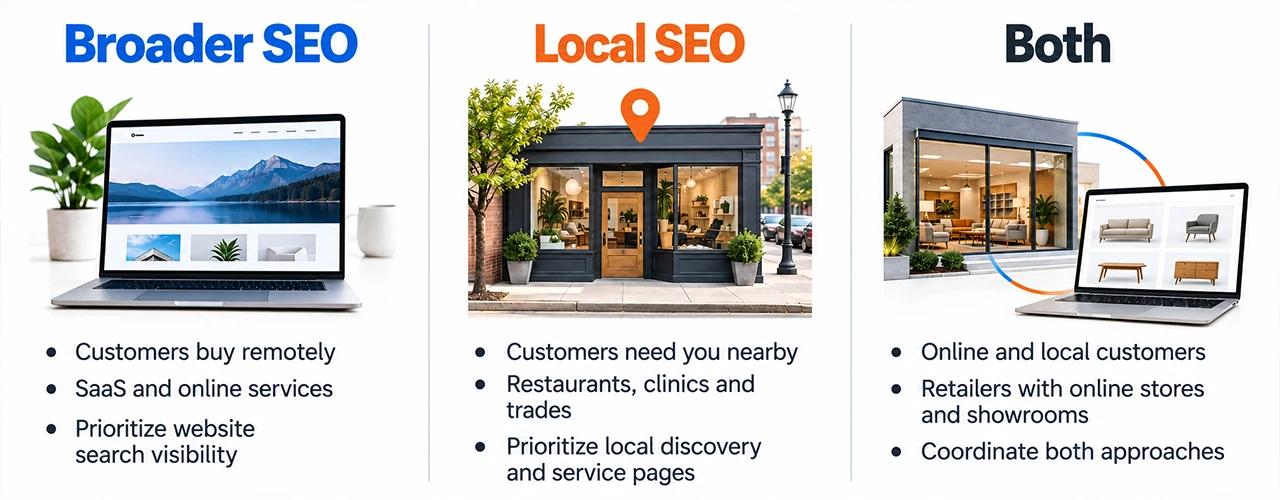
Choose your emphasis according to how customers find and buy from you.
Businesses that should prioritize broader SEO
Broader website SEO is usually a strong priority when you can deliver your product or service without depending on customer proximity.
- SaaS companies: Reach buyers researching problems, features, integrations, and alternatives.
- E-commerce businesses: Help shoppers discover product categories, individual products, and buying advice.
- National brands: Build visibility across the markets where their products or services are available.
- Online service providers: Explain specialist expertise to customers who can work with them remotely.
For example, an online training company selling courses nationwide would usually gain more from relevant course and subject pages than from trying to attract nearby foot traffic.
Businesses that should prioritize Local SEO
Local SEO is a strong starting point when customers need a nearby provider, visit your premises, or require someone to travel to their property.
- Plumbers and other trades: Attract enquiries from within a practical service area.
- Restaurants: Help customers compare menus, hours, locations, and dining options.
- Healthcare providers: Explain available services and support local appointment enquiries.
- Local service businesses: Make coverage, availability, and contact options easy to find.
- Retail stores: Help shoppers discover nearby premises and plan a visit.
Businesses that need both
Many businesses have more than one route to revenue. Furniture retailers may sell nationwide while attracting local showroom visitors. Clinic groups need strong service content and accurate location information, while consultancies may serve both remote and nearby clients. In each case, use one coordinated strategy with distinct page purposes and location responsibilities. “Both” does not require an equal budget split.
Can Local SEO Replace Traditional SEO?
A local-first programme may be enough for a business whose entire market is nearby, especially when its website already works well. That programme can focus on the profile, reputation, essential service pages, and accurate business information.
However, Local SEO does not remove the need for website fundamentals. Customers may still visit the website to assess expertise, check services, compare options, or request a quote.
Broader SEO becomes more important when you sell beyond your immediate area, offer online services, or need educational content to support a longer buying decision.
A neighbourhood restaurant may need a clear menu and booking journey before investing in a large blog. A specialist equipment supplier may need substantial product education even if it also has a local showroom.
Benefits of Combining SEO and Local SEO
Combining the two can support the full path from discovery to purchase:
- More relevant search visibility: Reach people through useful website pages and local business results.
- Better customer reach: Address both wider product demand and location-specific needs.
- Additional website traffic: Give searchers clear reasons to explore services, products, and expertise.
- More opportunities for local leads: Connect business discovery with calls, bookings, and visits.
- Stronger brand credibility: Present consistent information and useful evidence across the website and business listings.
These are potential benefits, not automatic outcomes. A weak service offer, difficult booking process, or missed enquiries can limit the value of improved visibility.
Common SEO and Local SEO Mistakes
- Ignoring Google Business Profile. Outdated hours, missing services, or an unsuitable category can make a business harder to evaluate.
- Targeting the wrong keywords. High traffic is not valuable if the visitors need something you do not provide or live outside your service area.
- Publishing poor-quality content. Generic explanations rarely answer the specific questions that stand between a visitor and an enquiry.
- Neglecting location information. A multi-location website needs to make it clear which services are available at each branch and how customers can contact it.
- Treating a service area as a ranking guarantee. Do not assume that listing every nearby town makes your business equally visible across them. Distance remains relevant in local results.
- Failing to track business outcomes. More impressions or call-button clicks do not automatically mean more paying customers.
- Assuming local competition is easy. A small geographic market can still contain established competitors with strong reputations and useful websites.
How to Build an Effective Search Strategy
1. Define the business outcome
Decide whether the priority is store visits, booked appointments, product sales, qualified leads, or expansion into another market. Set a measurable baseline before making changes.
2. Identify who you can serve
Document customer needs, delivery options, service boundaries, and relevant locations. This determines whether your search opportunity is mainly local, broader, or mixed.
3. Research queries and inspect the results
Group searches by intent. Look at whether results favour product pages, guides, service pages, or local listings. This helps you choose the page or profile work that fits the query.
4. Improve the essential website pages
Fix access problems and strengthen the pages closest to a purchase decision. A clear service page and working enquiry form may deserve attention before another blog.
5. Strengthen the local presence where relevant
Maintain eligible profiles, correct business information, improve location pages, and establish a consistent process for handling reviews. Assign responsibility for each branch if there are several.
6. Create content that resolves buying questions
Use questions from sales conversations and customer support to identify useful topics. Explain suitability, process, limitations, and next steps. Link educational content to the relevant service or product page when that helps the reader.
7. Measure results and adjust priorities
Review search visibility alongside lead quality and revenue. Expand activities that attract suitable customers, and improve pages that receive relevant traffic without generating enquiries.
For a limited budget, begin with the largest identifiable gap. Poor local visibility calls for different work than strong traffic with a broken booking process.
How to Measure SEO and Local SEO Success
Website SEO metrics
Use Google Search Console to understand impressions, clicks, click-through rate, and average search position. Examine relevant queries and landing pages rather than relying only on site-wide averages.
Use website analytics and sales records to track:
- Organic traffic to commercially relevant pages.
- Enquiries, bookings, purchases, or other meaningful conversions.
- Conversion rate from organic visits.
- Qualified leads and revenue associated with those visits where attribution is available.
Keyword rankings are useful diagnostic information, but the business question is whether better visibility brings suitable customers.
Local SEO metrics
Monitor Google Business Profile views, website clicks, call-button clicks, and direction requests where available. Google’s reported “calls” measure taps on the call button, not confirmed conversations. Direction requests are not proof of a store visit. Profile performance can also include Google Ads activity, so it should not automatically be labelled purely organic.
Also review local keyword rankings across representative locations, customer review trends, appointment data, and qualified enquiries by branch. Separate Maps positions from website organic rankings.
Compare equivalent periods and account for seasonality. A seasonal business can improve its search performance while still receiving fewer enquiries in a quieter month.
How TechHaz Helps Businesses Improve Search Visibility
As a digital transformation and IT solutions company, TechHaz offers services that connect search visibility with website performance and measurement. Its SEO, Local SEO, content strategy, analytics, and conversion optimization services can support different parts of the customer journey.
The useful starting point is identifying the constraint. A business missing relevant searches needs visibility work. A business receiving suitable visitors but few enquiries may need clearer pages, a better offer explanation, or an improved conversion process.
A coordinated plan connects those needs: choose the right searches, build useful pages, maintain local information where relevant, and measure which activities produce qualified enquiries. This keeps SEO decisions tied to business goals.
Choose Your Focus Around How Customers Buy
Begin with where you can deliver value. If customers need you nearby, prioritize local visibility. If they can buy from anywhere in your market, build broader website visibility. If both routes matter, give each a clear role.
The strongest SEO strategies for businesses connect relevant searches to accurate information, useful pages, and an easy next step. Judge the work by the customers it helps you reach and serve.
FAQ's
Is Local SEO part of SEO?
Yes. Local SEO applies SEO fundamentals to location-based searches and adds activities such as business profile management, local listings, and location-specific information.
Is SEO better than Local SEO?
Neither is universally better. A nationwide online store should usually prioritize broader website SEO. A neighbourhood service provider should emphasize local visibility. A business with both kinds of customers may need both.
Do small businesses need Local SEO?
Small businesses that serve nearby customers often benefit from Local SEO. It can help potential customers find their services, assess their reputation, and contact them. An online-only small business may have different priorities.
Can a business use SEO and Local SEO together?
Yes. For example, a retailer can optimize product pages for online purchases while maintaining profiles and location pages for its physical shops. Both activities should support the same business goals.
Should a business with a limited budget focus on SEO or Local SEO?
Start with the searches most closely connected to customers you can serve. For a local trades business, that may mean its profile and core service pages. For an online seller, it may mean product categories and checkout improvements. Expand once the fundamentals and measurement are in place.